

Company wins stuff!

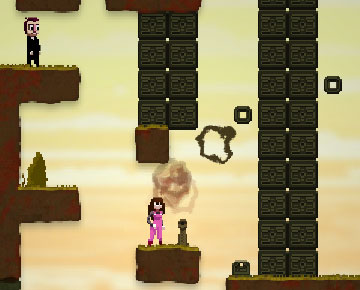
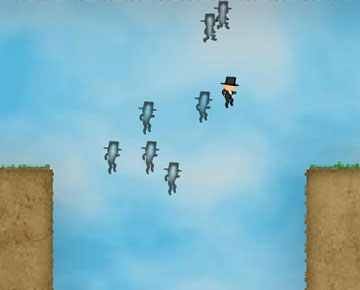
The Company of Myself just won the award for Best Indie Game at the 2010 Mochis, which is a part of the Flash Gaming Summit.  I couldn’t make it out to the event because it’s in California and I’m not, but David, the music guy for Company, got out there and accepted the award in my absence.  I’m also nominated for some kind of “rising star” award from the Tech Council in my area, but that’s not until early April.  Interestingly I got the phone call for that while I was waiting on the announcement about the Mochis.

6 Comments

Green squares and such.

I keep track of all the comments on the site, but I watch the comments for the Grief demo particularly closely, because it’s the project that stands as the most important to me.  Company did extremely well and got me a fair bit of recognition, and a lot of that is due to extensive testing and feedback from Average Joe, the very best and most influential member of my audience.

(For those just joining us, Average Joe is anyone and everyone in my audience.  That includes you.)

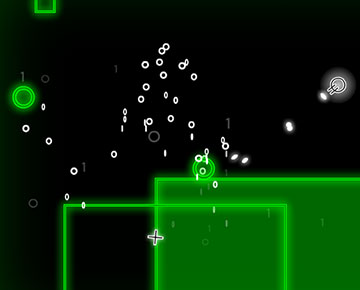
Something that comes up here and there is the green square that you play as in the current demo.  A lot of people seem to think that this is actually the art for the character (Henry) in the game.  As it stands, I haven’t locked in a character artist for Grief, so I don’t have an nicely animated man running around, and instead, all we get is a lovely little placeholder graphic, which is the green rectangle.

Way back at the beginning of my work on Company, I used similar placeholder art for the character, Jack.  Instead of green, he was a red rectangle.  The same assumptions were made back then–People thought that the red rectangle was the final character art, and I had to explain myself, much like I’m doing now.

So, then, here’s The Point:  As with everything in the Grief demo, the character graphic isn’t final.  Even the things that already look “good” (backgrounds, crates, effects, etc) aren’t final.  It’s all going to change in some way or another before the game is released.  And as it stands, there’s no story or puzzle solving in the demo, but of course, they’ll be in there eventually.  And yes, the gun fits into the story.  And no, this isn’t a shooter.  For a more detailed explanation, check the beginning of this post.

Breach is close to finished, now, as is YFYIAR.  They both are mainly just missing sound.  YFYIAR also needs a sponsor, but it’s understandably difficult to find one–The game is pretty risky from a business perspective, just because it’s a text game.  If you’re a sponsor with some cojones, be sure to give me a ring.

No Comments

Pieces start to fit together.

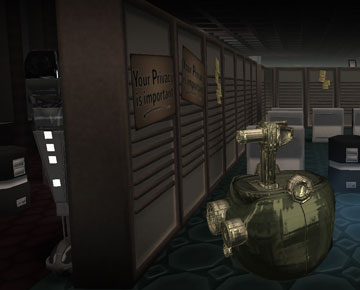
Give the Breach 3 demo another try.  It’s got some new goodies, including a more standard level progression (no more of that slider business) and some personality.  The game is now set inside of an AI, where you are tasked with removing viruses that are corrupting her systems.  She talks to you between levels.  It gives me lots of room to write, which is always fun as hell for me, and the game can get some humor and mood chucked in there for good measure.  Bonus points:  This is the same type of AI as the one featured in You Find Yourself In A Room, and the much more belligerent AI from that one can make appearances here.  The two games tie in with each other in at least a relatively interesting way.

Oh, also, make sure you try out the Zero Writes.  They’re bombs that kill everything on the screen.  I’m really satisfied with how they feel at the moment, and I can’t wait to get sound worked in so that these guys can make some noise.

No Comments

The sense of progress.

Most of my dev time lately has been spent on Breach 3, which won’t be called Breach 3, but that’s still what it is, so whatever.  YFYIAR is pretty close to being done, and at this point I’m waiting on David to hammer down the music (which is approaching something awesome very quickly) and sound (which ought to add something nice to things).  Grief is briefly paused while I finish up these other projects.  Chris is still messing around with art styles in various mediums, so progress is being made there, it’s just not progress that I’m responsible for.

Anyway, Breach 3.  I haven’t said anything about it yet, other than tossing out a quick demo (which is updated now, by the way, so go play it).  The game is my attempt to maneuver around modern casual game design–Upgrades are very prominent, because they give you a very direct sense of progress.  It’s also very un-punishing:  When you successfully complete a round, you get a bonus.  When you fail, you aren’t penalized, but you just don’t get the bonus.  Even though it’s still obviously better to complete a round, losing doesn’t seem to be a bad thing.  Instead, it’s just not as good. The bonus is extra, so failing to get it isn’t bad.  It’s just not as good as it could have been.  It’s a euphemism for failure.

Also, something that I enjoy way more than I should:  When you complete a round or visit the upgrade shop, the titles of the screens are randomized.  You get a different “you win” or “you lose” message each time, and the upgrade shop has various titles.  It doesn’t add anything in the utilitarian sense, but it’s just some extra flavor.  We did this a bit in Spewer, too–When you completed a level, you were given a few statistics (steps taken, jumps, etc).  The last statistic was always a random statistic with a random value (for instance, “Laws broken: 6″).  I got a shitload of chuckle-worthy emails asking about some of those.

Oh, and one of the titles for the upgrade shop is “Happy Item Room.”  If you understand this reference, then you are a superhero and I’m sending the president to your house to give you a handshake and a beer.

2 Comments

Some insights about loud things.

I’ve gotten some questions lately about the gun in Grief.  The general consensus is that Company was a quiet, thoughtful game, so why is the sequel going to be a mindless shooter oh god it’s going to be horrible why oh why is it a shooter?

To sum things up, Grief isn’t a shooter.  Grief is a puzzle game.  There are no enemies to shoot.  The gun ends up being purely a tool that you use in solving puzzles.

Aside from the game mechanics involved, having it be a gun is pretty important to the mood of the game.  The second chapter in Grief is Anger, and this is when Henry gets his pistol.  He’s frustrated with everyone and wants to feel powerful–A pistol sums that up in one concise package.  The real trick is going to be making sure that getting a gun feels like an important event, like it would be in real life.  Having a gun in a video game is often par for the course, so there’s no real impact when you get one.  In Grief, we’re going to have to set this up thoughtfully enough to make it feel genuine.

Substantial, empowering, and most importantly, somewhat dangerous.

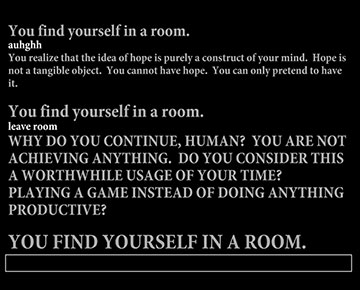
As a side note, I’m back to work on You Find Yourself In A Room.  It’s not going to be entered in the JayIsGames contest, because A) it would be disqualified anyway, and B) I already missed the deadline.  The demo for that one is updated with some actual content.  There are just three simple levels at this point.  Hopefully it’s somewhat clear how the game’s flow is going to work–It starts out pretty straightforward, and slowly gets sick of you.  Then it starts to resent you.  Then it starts to hate you.

It’s fun as hell to write, by the way.

1 Comment

Deja Vu…

I feel a little strange bringing this up, but whatever.  It made me chuckle a bit.

Here’s a game for you to try out.  It’s a moody little puzzle game about a lonely protagonist who can make copies of himself (by pressing the space bar).  He can stand on his copies, and his copies can stand on him.  He talks to himself throughout the game, which is shown as text overlays that appear over the level art.  The music featured is an original song, focusing on lonely sounding piano work, with some synth thrown in for good measure.  When he is limited in the number of copies he can make, the number left is shown as a number in the top left corner.  His chief personal motivation ends up being a girl.  The goal for each stage is to get to the square shaped exit.  Sometimes there are platforms that only copies can pass through, and sometimes there are platforms that only the original character can pass through.  The ground is a dull brown with grass on top.  Each level is exactly the size of the screen, so there is no scrolling.

Now, here’s the kicker.  I’m not talking about The Company of Myself.  I’m talking about Little Thing.

Play Little Thing

Anyone else feeling a little deja vu?

10 Comments

Finally, some story info for Grief.

I figure I’ve held off long enough, and since no one really knows about me anyway, there’s not a whole lot of point in keeping secrets.  Here’s how Grief works.

Grief is about the psychologist from the end of Company.  His name is Henry.  Near the beginning of the game, he finds out that he is dying of a newly discovered illness.  The rest of the game is split up into chapters that are based on the five stages of grief.  These are Denial, Anger, Bargaining, Depression, and Acceptance.  The player unlocks abilities that coincide with the current stage.

There are four characters in Grief.  Henry is the lead.  His daughter, Liz, is the most directly affected by Henry’s illness, though she doesn’t understand it, since Henry doesn’t want to admit to her that he is dying.  Dr. Parson shows up periodically to study Henry’s illness, though it’s clear that he has no intention of finding a cure.  He is only interested in making a name for himself.  Finally, the grim reaper shows up periodically to help Henry understand and manage his fate.  The grim reaper is interpreted differently than the average “black cloak and sickle” that we’re all accustomed to.  In Grief, Grim looks like an average person (In fact, in this case, he looks like Henry).  He’s generally laid back and calm; possibly indifferent.  He’s not trying to show off and terrify people.  Intimidating because of his position, maybe, but not because of his demeanor.

If you take a look at the current version (the tab near the top of the page, under the title), you can test out the first version of the gun that Henry acquires at the beginning of Anger.  For those who are interested, the bullets are physically simulated–They have mass and all that.  In certain cases, it’s possible to bounce one off of something and hit something else.

I’ve also been looking around for voice actors and a character artist.  I’ll let everyone know once I’ve got a team on lock down.

6 Comments

Some design edits for Grief…

So, Grief was originally supposed to be a game that featured pretty big levels that contained lots of little challenges that you could approach in any order.  I like the idea, but I don’t think it’d quite work out in the end–It doesn’t have enough focus.  I think I’m going to instead aim for an approach more similar to Company–Small levels that feature one main challenge per level.  It’s much easier for me to control, design-wise, so I think I can create a tighter overall product like this.  As a side effect, smaller levels means less stress on the physics engine, which means better performance on slower machines.  Box2D is incredibly fast, but even so, better performance is better performance.

There are still more design problems to solve, but I’m getting much closer to having a full view of things.  The story is reaching some awesome places as well.  This is going to be good.

No Comments

More info.

Since I still don’t have a title for it yet, I’m going to be referring to the new game as Grief for the time being.  I wish that Grief would work as a final title, because it does have a bit of zing to it, but it’s completely un-Google-friendly.  Way too common of a word for a Flash game that relies so heavily on the viral nature of the internet.

So, Grief.  The story is coming along very nicely–I’ve got some good ideas cooking.  It’ll turn out good.  I still approve of Company’s ending, but it’s a little too out of left field for me to be completely satisfied.  A really good twist ending should come from somewhere that makes sense, while still being surprising.  I don’t know whether or not Grief will have a twist ending.  It’s possible.  We’ll have to wait and see.

I did some more work on the engine and editor.  They’re both coming along gorgeously.  The editor is going to be capable of some pretty cool shit by the time it’s done.  The engine has some basic postprocessing stuff worked in now, too–This is possible because I’m using my own bitmap renderer instead of using Flash’s standard stuff.  At this point there are two effects.  The first is a desaturation filter, which just takes out all the color in the image.  The second is gloom, which is like the opposite of bloom.  Bloom makes bright light sort of spill out into shapes around it.  Gloom does the same thing with dark areas.  Much more fitting to the tone of the game.

More editor work for now, and we’re getting ready to start working with the game’s visual style.  Should be an interesting process, for sure.

No Comments

Grief.

So, a few updates.

First off, I don’t know whether or not the text game will get finished–I’ve got more important things to work on, since that was just a “for fun” sort of project.  I still have no intention of actually competing in JayIsGames’ casual game design competition, because as I said before, if I submitted my game, it’d get disqualified.  We’ll see what kind of time I have to work on it.  It’s still a possibility.

Second, and more importantly, I finally started writing code for the next “big” project, which is a semi-sequel to Company.  The theme of the game is grief, but I don’t want to give too much info on how it factors in quite yet.  I can handle talking about more vague stuff, though, so here’s a few quickies:

It’s a story based platformer that is heavy on exploration and discovery.  You play as a character from Company, but not Jack, the original protagonist.  That only leaves two other options, since Company doesn’t have a whole of characters.  The game is set in the same universe, but it stands alone, so you wouldn’t need to have played the original to understand what’s going on.  I’m using Box2D to give the game some physics, but I don’t really want to call it a “physics based platformer,” since the focus isn’t on the physics.  There’s a strong trend right now, especially in Flash games, to base an entire game on physics (usually with Box2D because it’s so damn fast).  It works, and these games can definitely be fun, but I’m starting to get a little sick of it.  Maybe that’s just me.

I’ve got pretty big plans for it, so I’m gonna have to be getting help from more people than I’ve ever had before–The game needs lots of music, at least three voice actors, and probably two artists (one for static things like the level art, and one for characters and animations).  I’m pretty set on music and one of the artists, but the rest is up in the air for now.

This game is going to require an absurdly powerful level editor, and like Company, I probably won’t be able to release it with the game.  It’d just be too hard to make it userfriendly.  I might put it up on my site though, once it matures a bit, just so you guys can check it out and fiddle with it.

1 Comment